Your mock transcript says more than your answer did
A practical behavioral mock interview guide built from the public deliberate-practice canon — Anders Ericsson on feedback loops, Aline Lerner on interviewing.io interview data, Gayle Laakmann McDowell on behavioral prep, Julia Evans on reading your own interview transcript, and Yangshun Tay on the question families that repeat.
The canonical framing for why behavioral mock interviews fail is not from an interview coach. It is from Anders Ericsson, the Florida State researcher who spent four decades on deliberate practice and wrote Peak: Secrets from the New Science of Expertise (2016). Ericsson's core finding is that "practice more" does not produce expertise. What produces expertise is immediate, specific feedback against a measurable standard. Most skip exactly that feedback loop — they produce reps, not corrections.
A behavioral mock is not a rehearsal. It is a diagnostic. The rep generates data. The transcript review is where the learning happens. Every mock should produce exactly one correction for the next rep — not five.
The pattern this page is built on comes from three public sources stacked together:
- Aline Lerner at interviewing.io, who has published the rare dataset of 600+ technical interviews with specific callouts on where strong engineers leak signal on ownership, linear communication, and risk framing.
- Gayle Laakmann McDowell in Cracking the Coding Interview, whose behavioral chapters lay out the story-bank approach most of the industry now uses.
- Yangshun Tay's Tech Interview Handbook, which organizes the 30 most common behavioral questions by signal type — conflict, failure, influence, ambiguity.
The method below stitches Ericsson's deliberate-practice loop onto the interview sources. Read the transcript. Find the sentence. Fix one thing. Next rep.
Why the transcript changes everything
Most mock-interview pairs run through a story, hear "sounded good," and move on. The problem with that feedback loop is the one Cal Newport names in his deliberate-practice writing: unaided memory is a poor measuring instrument. What you remember about your answer is a compressed, flattering summary. What the transcript contains is the evidence.
Aline Lerner's 600-interview retrospective flags the same pattern on the technical side that shows up on the behavioral side: strong engineers with real experience still lose signal on ownership, linear communication, and whether the risk at the center of the story is actually visible. Her team's voice-modulation experiment — swapping candidates' voices while keeping their answers identical — found that interviewer perception tracks delivery markers the candidate cannot self-assess in real time. A partner's "sounded solid" misses those. A transcript catches them.
Julia Evans at jvns.ca, writing on her own interview preparation years, makes the same move for a different reason — she posts her own technical writing back and reads it as a stranger would, to find the places where her own logic is only legible to her. A behavioral transcript is the same exercise for story delivery.
The 45-minute mock format
Behavioral mocks get mushy without structure. The 45-minute format below is synthesized from McDowell's Cracking the Coding Interview behavioral appendix, Tay's Tech Interview Handbook prep flow, and the interviewing.io session structure that underlies their published data.
Minutes 0-5: calibrate
Before the first question, get aligned:
- What level and role is the target?
- What round type are you simulating — behavioral screen, hiring manager, bar raiser?
- Which story families do you want pressure on?
This matters more than it looks. Behavioral prep for a mid-level IC loop is not the same as prep for staff, manager, or hiring-manager rounds. McDowell's story-bank framing in Cracking the Coding Interview explicitly warns that reusing senior-level stories for a staff-level bar fails on scope, not on delivery.
Minutes 5-30: answer 3-4 real questions
Use questions that force range. Not four versions of a favorite story. Tay's behavioral question inventory organizes the canon by signal type — conflict, failure, influence, ambiguity — which is the right way to cover the families interviewers rotate through:
- Tell me about a time you disagreed with someone senior.
- Tell me about a failure.
- Tell me about a time you made progress with incomplete information.
- Tell me about a time you influenced a decision without authority.
The point is not to get through a list. It is to find where stories collapse under pressure. A decade of production experience does not prevent freezing on "tell me about a failure" if that family has never been practiced out loud.
Minutes 30-40: force the follow-ups
This is where the story either holds up or falls apart.
Ask:
- Why was that the right trade-off?
- What did you miss?
- How did you know the result came from your change, not something else?
- What would you do differently now?
- Why did the other person disagree?
The misread here is common: candidates think the interviewer is trying to trip them up. The interviewer is trying to find out if the story is real. A real story gets sharper under follow-ups. A rehearsed story gets vaguer. Lerner's common-reasons-candidates-fail post names this directly — the gap is usually not prep volume, it is prep depth.
Minutes 40-45: debrief with specifics
Do not end with "that was good" or "try to be more confident." That is not feedback. That is noise.
End with:
- One story that was strong and why.
- One story where ownership was blurry.
- One place the tension was undersold.
- One follow-up that exposed a gap.
- One rule for the next mock.
That last line is the whole point. Lara Hogan's Feedback Equation post — the canonical public write-up on feedback structure — is built around the same premise: feedback without a specific observation and a specific request is not actionable. The one-rule-per-mock constraint is the debrief version of Hogan's structure.
The four-pass transcript review
The separator between a decent behavioral answer and a strong-hire answer is almost never the story. It is whether the hard sentence — the one where the trade-off, the disagreement, or the mistake became real — is visible to the interviewer.
Tay's behavioral interview guide frames this as preparing 3-5 stories with genuine ownership and impact, not participation. The four passes below use the transcript to check exactly that.
Pass 1: ownership
Highlight every "we" in the transcript.
Then ask:
- What did the candidate specifically drive?
- Which decision was the candidate's, and which was the team's?
- Would a listener know what changed because of the candidate?
If the answer to that last one is no, the story has a hole. The "we" problem is the single most common signal leak in behavioral transcripts — Lerner's behavioral evaluation post for Meta-style loops calls this out explicitly. Strong engineers default to inclusive language because that is how they talk at work. In an interview, inclusive language makes the candidate invisible.
Pass 2: tension
Find the exact sentence where the story became difficult.
If that sentence does not exist, the story sounded too easy to the interviewer.
Good tension looks like:
- Reliability versus deadline.
- Local team goals versus platform consistency.
- Disagreement with a manager or partner team.
- Incomplete data with a real business deadline.
Weak answers hide the hard part until halfway through. By then the interviewer has already formed an impression. This is the failure mode the eng-leadership newsletter's big-tech behavioral guide flags as "success narrative" — stories that sound clean but contain no tension, which read to an interviewer as "this candidate worked on a project."
Pass 3: structure
Check whether important context shows up too late.
Burying crucial setup in the action section — usually because the candidate was rushing to sound proactive — makes the answer feel nonlinear. A nonlinear answer is harder to trust.
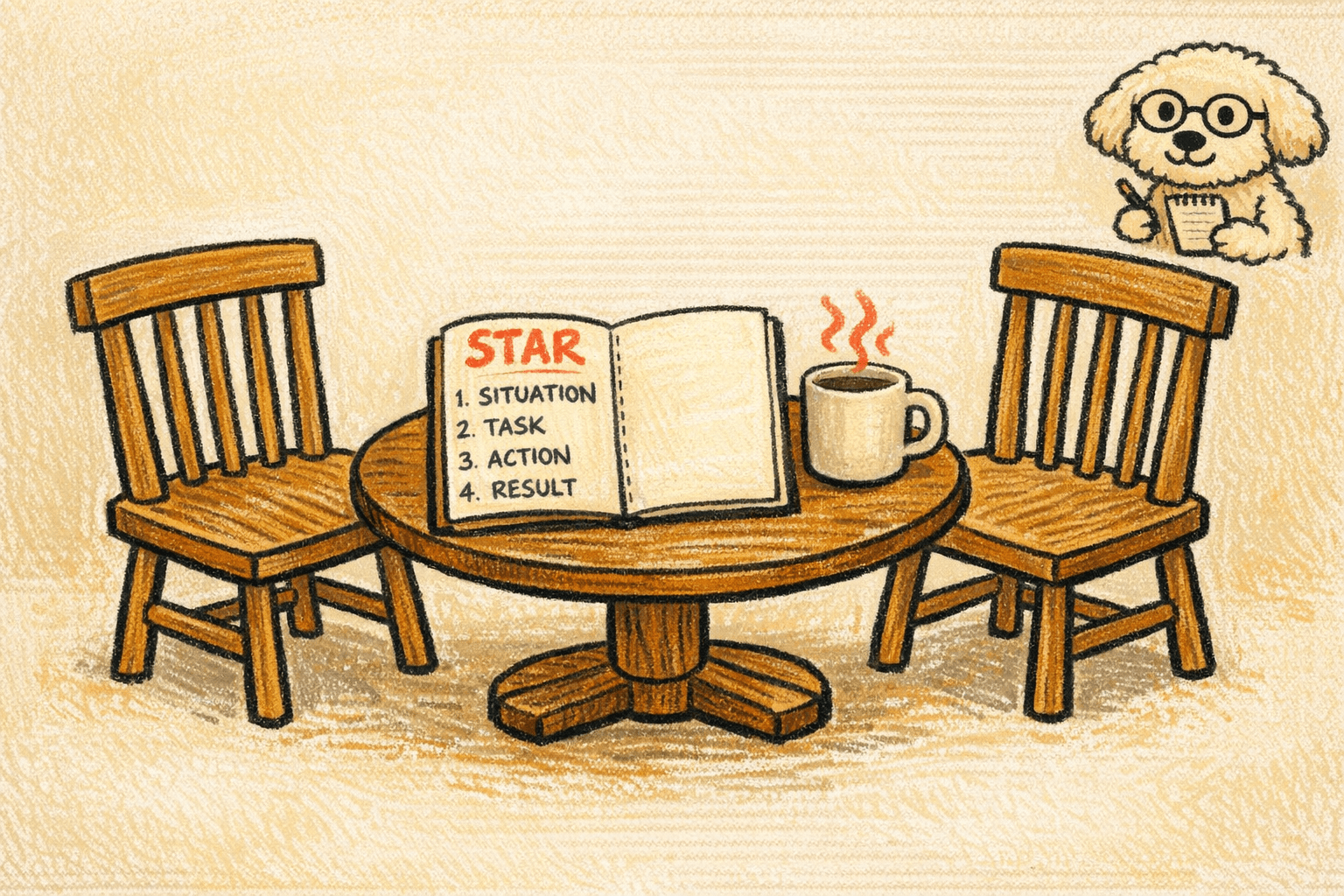
MIT Career Advising's STAR worksheet is the clearest public template for ordering. The framework is not the point. The ordering is.
Pass 4: follow-ups
Write down the follow-up that hurt the most.
Usually it is one of:
- A number the candidate did not have.
- A trade-off the candidate did not explain.
- A disagreement where the other side was never shown fairly.
- A reflection that sounded too polished to be believable.
That is the part to fix before the next rep. Not all four passes. Just the one follow-up that exposed the biggest gap — Ericsson's deliberate-practice loop is built around the single-correction constraint. More than one correction per rep is not practice, it is rework.
What useful feedback actually sounds like
If a mock partner's feedback is about vibes, the mock is not doing its job. The target interview-answer length — 90 seconds to 2 minutes per story — is the window; "be more confident" wastes that window. Daniel Coyle in The Talent Code (2009) is specific on this: feedback that points to a vague quality ("energy," "confidence," "presence") does not change behavior. Feedback that points to a specific moment does.
Useful feedback is concrete:
- "The story was good, but the specific decision the candidate made was never clear."
- "The action was clearly described, but the risk was undersold."
- "The setup arrived too late — the action section was confusing without it."
- "The conflict was handled well, but the other side's view was never shown fairly."
- "The reflection was clean, but it did not change the candidate's operating model."
Every piece of feedback should point to a specific moment in the transcript. If it does not, it is a feeling, not a finding.
The mistakes that keep showing up
Over-rehearsing the wording
Prepared is good. Scripted is fragile. The goal is a story that can be explained cleanly from different angles, not a monologue that collapses the moment someone interrupts. Lerner's interviewing.io posts call this "fragile framing" — the story depends on a specific opening sentence that an interrupting interviewer will never allow.
Hiding the hard part
If the disagreement, the mistake, or the trade-off is not explicit, the story has no weight. A beautifully structured story about shipping a feature on time with no tension produces exactly one interviewer follow-up: "What went wrong?" If nothing went wrong, the answer is evidence of a project, not of judgment.
Too much "we"
The pattern shows up in Lerner's 600-interview retrospective and in every behavioral-rubric write-up since. "We decided" and "we shipped" and "we noticed." An interviewer cannot give credit for a team decision. The candidate has to be specific about what they drove.
Skipping the pause
Sometimes the strongest behavioral move is to stop and ask, "Do you want more depth on the decision itself or the team dynamics?" That keeps the answer interactive instead of scripted. Interviewers notice when a candidate reads the room — Orosz's hiring-software-engineers scoring rubric on the Pragmatic Engineer newsletter lists "calibrates to interviewer" as a distinct positive signal, separate from content.
Ending without a real lesson
Strong behavioral answers finish with what changed in the candidate's operating model, not just what happened that day. The eng-leadership newsletter's guide calls this the "impact chain" — the interviewer wants to see that the experience changed the candidate's judgment, not just that it had a happy ending.
The prep loop before the real round
- Start with Behavioral Interview Questions for Software Engineers to build the story bank before mocking it.
- Run one baseline mock with 3-4 questions from different families.
- Review the transcript the same day. Fix one pattern: ownership, tension, structure, or follow-ups.
- Run a second mock on different questions with the same correction goal.
- If the upcoming round is a hiring-manager screen, calibrate your final rep on leveling evidence and team-fit signal, not just on story delivery.
If the target company is Amazon-shaped, add Amazon Leadership Principles Interview Questions.
Go deeper — the reading list behind the method
- Anders Ericsson (Wikipedia) + Peak (Wikipedia) + Practice / deliberate practice (Wikipedia): the research foundation for "transcript + one correction per rep."
- Cal Newport (Wikipedia): deliberate practice applied to knowledge work — relevant because interview prep is knowledge work, not muscle memory.
- Daniel Coyle (Wikipedia) — The Talent Code (2009): specific on why vague feedback does not change behavior.
- Aline Lerner at interviewing.io — 600-interview retrospective, behavioral evaluation post, common-reasons-candidates-fail, voice-modulation experiment: the rare public dataset of what actually correlates with interview outcomes.
- Gayle Laakmann McDowell (Wikipedia) + crackingthecodinginterview.com: the story-bank approach most of the industry now uses.
- Yangshun Tay — Tech Interview Handbook: the canon question list, organized by signal type.
- Lara Hogan — The Feedback Equation and first-one-on-one questions: the canonical public structure for feedback that actually changes behavior.
- Gergely Orosz — Hiring Software Engineers on the Pragmatic Engineer newsletter: the scoring-rubric perspective.
- Julia Evans — interviewing category at jvns.ca: named-engineer perspective on reading one's own preparation back as a stranger.
- MIT Career Advising — STAR worksheet: clearest public template for ordering.
- eng-leadership newsletter — how to nail big-tech behavioral interviews: the "impact chain" framing.
- John Washam — Coding Interview University (GitHub): the 2016 deliberate-practice interview-prep manifesto — structurally adjacent for the mock-and-review loop.
Practice behavioral.
Explain your thinking like you're in the interview.
Fin and Coco are StrongYes editorial personas from the Council of Ternary Vertices — a trinary-star animal civilization that studies Earth's coding-interview process. Anecdotes map animal-universe experience to human interview mechanics; they are NEVER human-career claims. External citations link to public primary sources.
Aggregator edit built from the public deliberate-practice literature (Anders Ericsson's Peak, Cal Newport on deliberate practice in knowledge work, Daniel Coyle's The Talent Code) applied to behavioral interview rehearsal — with named-engineer practice sources from Aline Lerner at interviewing.io, Gayle Laakmann McDowell's Cracking the Coding Interview, Julia Evans's interviewing category at jvns.ca, Yangshun Tay's Tech Interview Handbook, Lara Hogan on feedback quality, and Gergely Orosz on hiring signal.
Last verified Apr 17, 2026.
Practice Behavioral.
Reading builds recognition. Explaining builds recall. Run these problems with Fin or Coco.