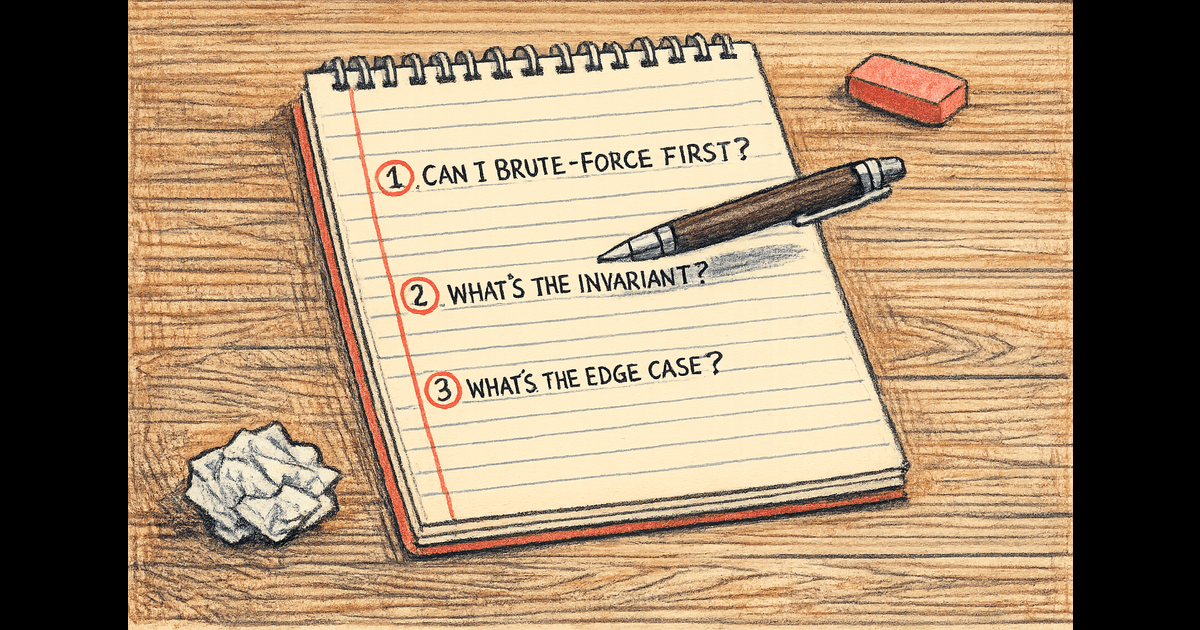
The 3 Questions I Ask Before Writing Any Interview Code
Most candidates start typing immediately. The best ones pause for 90 seconds. Here's the 3-question checklist that separates them.
You know the moment.
The interviewer finishes explaining the problem. There's a pause. And most candidates do the worst possible thing — they start typing.
I've watched hundreds of candidates do this. The ones who get offers don't. They pause for 60–90 seconds, ask 2–3 questions, and then touch the keyboard.
Here's the difference: they're running a checklist. Not consciously — it's muscle memory by the time you're good at it. But there are exactly three questions, and if you skip any of them, you'll waste 10 minutes going the wrong direction.
Question 1: "What am I actually being asked?"
Not the title. Not "it's a two-sum problem." The actual constraint.
Aleksey Kladov (matklad) puts it better than anyone: programming is all about building a precise understanding inside your mind. The code is secondary — the mental model is the thing. If your mental model is wrong, your code will be wrong no matter how fast you type.
Example: 'Find the longest substring without repeating characters'
What most candidates hear
"Longest substring" → sliding window → start coding
// Already writing a while loop...That 30-second difference — parsing the actual constraint vs. hearing the title — is worth 15 minutes of coding time.
Fin's rule: If you can't explain the constraint in one sentence without using the problem's title, you don't understand the problem yet.
Unlock the full guide
Complete walkthrough, diagrams, and practice problems — all included with StrongYes Pro.
Unlock with ProThis is how Fin coaches at strongyes.io — one question at a time, until the code writes itself. Try a session →
Practice pre-coding narration.
Explain your thinking like you're in the interview.
Sources:
- Kladov, A. "Look for Bugs" (2025) — on building mental models before code
- Kladov, A. "Kafka vs Nabokov" (2024) — on starting with the simplest working thing
- Post 1: Sliding Window vs. Two Pointers — The Invariant Question
Fin and Coco are strongyes.io editorial personas from the Galaxy of Animina. Anecdotes map animal-universe experience to human interview mechanics; they are NEVER human-career claims. External citations link to public primary sources.
matklad mental model thesis, interviewdb.io candidate behavior analysis, strongyes.io coaching data
Last verified Apr 12, 2026.
Practice Interview strategy.
Reading builds recognition. Explaining builds recall. Run these problems with Fin or Coco.