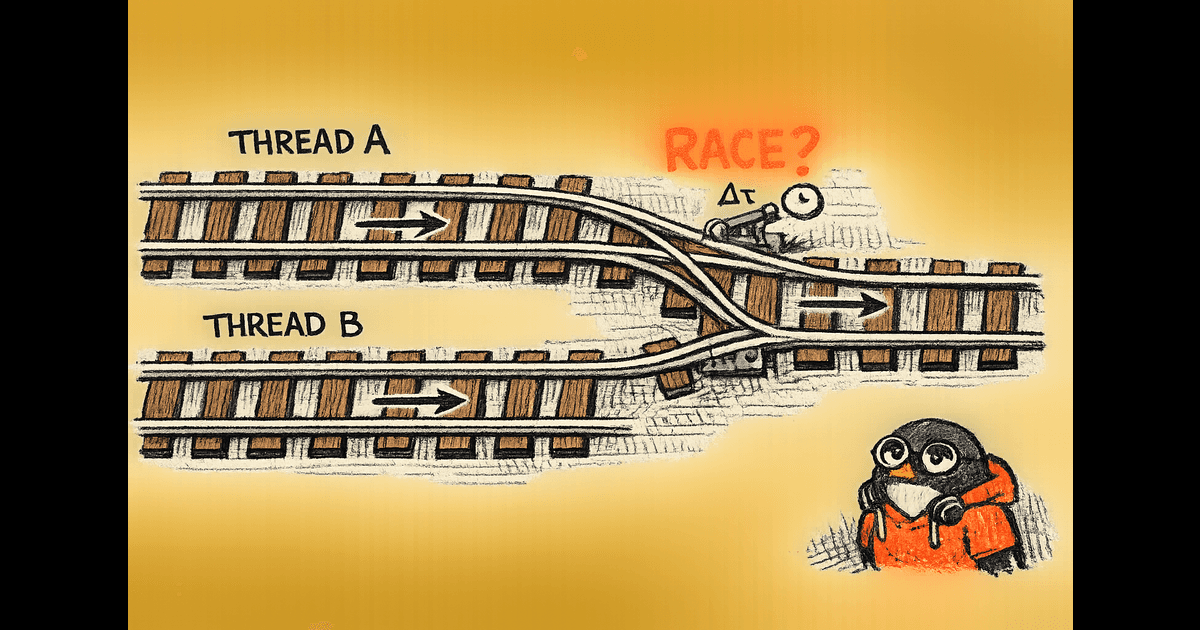
Concurrency is where juniors meet their first ghost
A practical concurrency interview guide for software engineers: the question families that repeat, how to talk about locks and worker pools without hand-waving, and the prep loop that makes multithreading rounds less chaotic.
Concurrency interview questions are rarely asking whether you can recite the definition of a mutex. They are asking whether you can name the shared state, protect the , and avoid creating a second bug while fixing the first one.
Concurrency is when your program runs multiple tasks at once that share data. Interview rounds test whether you can name the shared state, pick the right lock, and avoid a second bug. The primitives matter less than the discipline.
Concurrency is one of those topics candidates underestimate until it shows up in a systems-heavy or backend-heavy loop. The pattern across concurrency rounds is consistent: candidates can define a mutex, can define a deadlock, but the moment the interviewer says "how would you make this thread-safe?" they reach for a primitive before they have named what is actually shared. That is the miss. Educative's concurrency interview guide puts it well: these questions test whether you can efficiently reason about shared resources, not whether you have memorized API signatures.

“Name what's shared before you name the lock. Every 3am page starts with the reverse.”
In the StrongYes company corpus alone, Databricks and Snowflake call out concurrency or multithreading directly, Apple mentions practical concurrency, and Twitter/X blends concurrency into systems-flavored coding rounds.
Concurrency questions usually sit alongside Database Interview Questions in the systems corner of the loop. They go badly when candidates answer with textbook definitions instead of the actual failure mode.
What interviewers are actually testing
A strong concurrency answer usually proves five things:
- You can identify the shared resource or state.
- You can state the invariant that must stay true.
- You know when coordination is necessary and when it is just overhead.
- You can choose a primitive because of its semantics, not because you remember its name.
- You understand both safety and liveness: correctness matters, but so does avoiding deadlock, starvation, or unbounded backlog.
Interviewers trust candidates more when they say "the invariant is X" than when they say "I would use a mutex" too early.
The pick-your-primitive decision tree
Here is the same reasoning as a flowchart. Walk through it once — out loud if possible — before you name any primitive. The most common concurrency interview mistake is naming the tool before you name the access pattern, so this tree is designed to front-load the pattern question.
Guard clause first — do you have shared mutable state at all? If not — pure compute, immutable data, message-passing — you are done. No coordination primitive needed; just say out loud that there is nothing to coordinate and move on.
If yes, the right primitive falls out of exactly one question: what is the access shape?
Green terminals are the "you have room here" primitives — read-mostly or embarrassingly parallel. Amber is the regular-coordination layer (semaphore, queue, mutex) where you still have to name the invariant clearly but the primitive choice is mechanical once you do. Red is atomics — powerful but easy to misuse, because "I used CAS" does not help when your invariant spans two fields. Reach for a mutex first, switch to atomics only when the invariant is genuinely single-word.
The six concurrency question families
1. Concurrency vs parallelism vs async
- concurrency is coordinating multiple in-flight tasks
- parallelism is work happening at the same time
- async is a control-flow style that avoids blocking the caller while work waits elsewhere
freeCodeCamp's concurrency vs parallelism explainer uses a kitchen analogy that I now steal in every mock: concurrency is one chef switching between dishes, parallelism is multiple chefs cooking different courses. That framing helps candidates say the right thing:
- "The problem is coordination, not raw CPU parallelism."
- "Async helps when the bottleneck is waiting on I/O, not when the work is pure compute."
- "I do not need multiple threads just because multiple requests exist."
I have seen candidates lose this point by jumping straight to "I would spin up a thread pool" without first asking whether the bottleneck is CPU or I/O. Threads are a tool with cost, not a performance badge.
2. Race conditions and thread safety
This is the core family.
A race condition means correctness depends on timing. DigitalOcean's thread safety walkthrough demonstrates this concretely — two threads incrementing the same counter can produce a value lower than either expected, because the read-modify-write is not atomic.
The strongest answers do not start at the primitive. They start at the broken behavior. I tell every candidate: describe the bug first, then name the fix. Once you state the failure clearly, the primitive choice becomes easier.
Useful sentence starters:
- "The shared state is..."
- "The invariant I need is..."
- "The unsafe interleaving is..."
That structure is much stronger than saying "make it thread-safe" and hoping the interviewer infers the risk.
3. Mutexes, locks, semaphores, queues
This family checks whether you can choose the right tool for the access pattern.
- use a mutex when one critical section needs exclusive access
- use a read/write lock when reads dominate and the write path is rare
- use a semaphore when the resource has limited capacity
- use a queue or channel when coordination is better expressed as ownership transfer or bounded work
The real question is not "which primitive is fancier?" It is "what am I protecting or limiting?"
One practical interview example is a bounded worker pool:
const maxConcurrent = 8

func processAll(jobs []Job) {
    sem := make(chan struct{}, maxConcurrent)
    var wg sync.WaitGroup

    for _, job := range jobs {
        sem <- struct{}{}
        wg.Add(1)

        go func(job Job) {
            defer wg.Done()
            defer func() { <-sem }()

            process(job)
        }(job)
    }

    wg.Wait()
}
The Go Blog's pipeline patterns article by Sameer Ajmani covers the same fan-out/fan-in idea with channels — including the key insight that "closing a channel serves as an effective broadcast signal for cancellation across an unbounded number of goroutines." The important idea is not Go-specific syntax. It is the interview trade-off:
- without a bound, you can overwhelm CPU, memory, or downstream services
- with a bound, throughput becomes more predictable and back-pressure is explicit
If the interviewer asks "why not spawn one thread per task?", this is the answer path.
4. Deadlocks, starvation, and contention
Many candidates can define deadlock but still give designs that create one.
The recurring risks:
- two threads acquire the same locks in opposite order
- one long critical section blocks unrelated work
- retries or busy-wait loops keep losing the same race
- one writer or one hot key starves the rest of the system
The clean answer is to reduce the risk at the design level. GeeksforGeeks' deadlock prevention guide frames the canonical strategy: "assign each resource a unique number; processes can only request resources in increasing order of their numbers" — this eliminates circular wait without runtime detection. In practice:
- keep critical sections small
- use a consistent lock-ordering rule
- avoid holding locks across network or disk calls
- prefer ownership transfer or queues when shared mutation is getting messy
If you only remember one sentence, remember this one:
"I would first reduce contention by changing the shape of the shared work, then add locking to the smaller critical section that remains."
That sounds like engineering judgment, not vocabulary recall.
5. Producer-consumer and back-pressure
The most common weak answer is "I would use a queue" and then stopping. AlgoMaster's blocking queue design walks through the full implementation — single-lock vs two-lock approaches, condition variables for wait/notify, and why the bounded buffer matters for back-pressure. That level of detail is what separates a strong answer from a hand-wave.
A stronger answer sounds like:
- "The queue gives me decoupling, but I still need a capacity policy."
- "If consumers fall behind, I need back-pressure, dropping, or degradation."
- "The worker count should be tied to the bottleneck, not guessed from habit."
This is also where concurrency connects naturally to API Design Interview Questions and Data Engineering Interview Questions.
6. Visibility, atomics, and happens-before
This is the advanced family that catches candidates who think one shared flag is harmless.
The short version:
- seeing one write does not automatically mean you safely saw every related write
- atomics are for narrow synchronization needs, not for replacing every lock
- if you cannot explain the ordering guarantee, your solution is probably too clever
You do not need to turn the interview into a memory-model lecture. You do need
to know that "I set done = true" is not a full concurrency design by itself.
The safe framing is:
- "I would establish ordering with a lock, channel, condition, or other synchronization primitive."
- "I would use atomics only when the shared state is truly small and the semantics stay obvious."
That is usually enough depth for an interview unless the role is explicitly runtime, database-engine, or language-runtime heavy.
A good concurrency answer has five parts
When the interviewer says "How would you make this thread-safe?" or "How would you process this concurrently?", use this structure:
- Name the shared state or limited resource.
- State the invariant.
- Describe the unsafe interleaving or overload risk.
- Choose the primitive or coordination model.
- Name the trade-off you are accepting.
Example:
"The shared state is the account balance. The invariant is that each transfer either fully applies once or not at all. The unsafe case is two concurrent updates reading the same old balance. I would protect the update path with one consistent critical section or move writes through a single owner queue. The trade-off is lower parallelism on that path in exchange for correctness."
Common mistakes that cost easy points
Naming the primitive before naming the invariant
This is the single most common concurrency interview mistake I see. The candidate says "I would use a mutex" before they have said what the shared state is or what invariant they are protecting. It makes the answer sound memorized, and the interviewer knows it.
Treating concurrency as automatic speed
I have watched candidates add a thread pool to a problem that was I/O-bound on a single external API call — more threads just meant more contention on the same bottleneck. Extra workers can increase contention, context switching, memory pressure, and tail latency.
Solving a coordination problem with hope
Flags, retries, and sleep loops are not synchronization strategies.
Ignoring back-pressure
If producers can outpace consumers forever, your design is unfinished.
Using atomics because locks feel "too slow"
Atomics are sharp tools. Interviewers usually reward clarity over premature micro-optimization.
A short prep loop for concurrency rounds
- Rehearse the vocabulary precisely: concurrency vs parallelism vs async, race condition, deadlock, starvation, mutex vs semaphore.
- Practice two shared-state prompts out loud: one lost-update bug and one bounded worker-pool or queue question.
- Map the answer to your interview language. In Go, revisit channels and
mutexes. In Java, revisit
synchronized,Lock, and conditions. In Python, revisit coordination primitives and capacity control.
What to study next
If concurrency questions still feel fuzzy, do not study them in isolation forever.
Pair this guide with:
- Database Interview Questions for transactions and write conflicts
The goal is not to sound like a concurrency researcher.
The goal is to make the interviewer trust that, when two things happen at the same time, you know what can break and how to keep it from breaking.
Practice Concurrency.
Explain your thinking like you're in the interview.
Fin and Coco are StrongYes editorial personas from the Council of Ternary Vertices — a trinary-star animal civilization that studies Earth's coding-interview process. Anecdotes map animal-universe experience to human interview mechanics; they are NEVER human-career claims. External citations link to public primary sources.
Written in Fin's voice (AI-aware Shark, DSA + systems coach), grounded in the StrongYes company-guide corpus (Databricks, Snowflake, Apple, Twitter/X, Mistral) where concurrency and multithreading recur explicitly, plus the Go memory model and Python threading documentation for synchronization primitives. Zi the penguin interjects at the on-call framing.
Last verified Apr 17, 2026.
Practice Concurrency.
Reading builds recognition. Explaining builds recall. Run these problems with Fin or Coco.