Distributed systems without the buzzword soup
A practical distributed systems interview guide for software engineers: the question families that repeat, how to explain consistency and scaling trade-offs, and the prep loop that keeps senior-system rounds concrete.
Distributed systems interview questions are rarely testing whether you can recite CAP theorem on command. They are testing whether you can explain what breaks when one machine is not enough, and what trade-off you would accept to keep the product useful.
Distributed systems interviews sit next to Database Interview Questions in the systems corner of the loop. Across senior-level system design rounds, the distributed systems questions are where the research sees the widest gap between candidates who sound like they have operated real systems and candidates who sound like they read a textbook on the subway.
The System Design Primer still organizes the same fundamentals that show up in every interview loop: replication, partitioning, , queues, and consistency trade-offs. DesignGurus' 25 fundamentals guide frames it as building blocks — "use concepts as building blocks to construct a robust solution tailored to the question." That is exactly how the strong candidates approach it.
What interviewers are actually testing
A strong distributed systems answer usually proves five things:
- You can name the hot path before you name infrastructure.
- You can explain how data moves between services or machines.
- You know what can go wrong under retries, duplication, delay, or partial failure.
- You can choose a trade-off on purpose: latency vs durability, freshness vs simplicity, throughput vs coordination.
- You can speak in stages instead of pretending the first version already runs at planet scale.
Interviewers want to trust that you understand the cost of distributing work, not just the upside.
The six distributed-systems question families that keep repeating
1. Replication and consistency questions
This family is about one uncomfortable fact: once data lives in multiple places, it can disagree.
Green is the cheapest: the analytics path can be minutes stale and no user notices. Amber is the working zone where most product surfaces live — read-your-writes and bounded staleness give you correctness where it matters and cost where it does not. Red is the expensive tool: linearizable writes pay real latency and availability cost, so you spend them only on the paths where a stale read would violate a product like "no two users got the same seat."
Tie consistency to product behavior.
- social feeds can usually tolerate slightly stale counts
- inventory, payments, and reservations cannot
- dashboards can often be eventually consistent if the contract is clear
Good language sounds like:
- "I would start with one write leader and read replicas because the write path stays simpler."
- "I would spend stronger consistency on the reservation path, not on every analytics read."
Jepsen's consistency model reference maps how these models relate to each other — linearizability, serializability, eventual consistency all form a hierarchy of ordering guarantees. You do not need to memorize the hierarchy, but you do need to know that "eventual consistency" is not one thing — it is a spectrum. I have watched candidates say "eventual consistency" as if it ends the discussion. It does not. How stale is acceptable, and on which path?
2. Partitioning and shard-key questions
This family is really about distribution of load.
Start by naming the access pattern, then the likely hotspot.
- user-based sharding is a clean default when most traffic is per-user
- tenant-based sharding gets risky when one tenant can dwarf the rest
- time-based partitioning helps append-heavy data, but it can hurt cross-time lookups
The real answer is the trade-off between balanced load and sane query patterns, not "just shard the database."
3. Load balancing, caching, and hotspot questions
The recurring concepts are:
- stateless app instances behind a load balancer
- cache-aside or read-through caching
- TTL and invalidation
- cache stampede and hot-key protection
Good language is:
- "The hot path is read-heavy and repeatable, so I would cache close to the read path."
- "The database stays the source of truth, and invalidation matters more than just adding Redis."
- "If one key gets hot, I need request coalescing or stale reads so one miss does not stampede the store."
4. Queues, async work, and back-pressure questions
This is where distributed systems stops looking like databases and starts looking like workflow control.
The useful question is not "should I use a queue?" It is: what must happen inline for the user, and what can happen later?
Queues absorb bursts and decouple services. Confluent's event-driven architecture guide explains the pattern well — systems detect, process, and react to events as they happen. But queues do not remove duplicates, retries, or backlog growth.
A strong answer usually mentions:
- producer and consumer boundaries
- retry policy
- dead-letter or replay path
- handling
- back-pressure when consumers fall behind
def handle_event(event, store):
    if store.was_processed(event.id):
        return "duplicate"

    with store.transaction():
        do_side_effect(event)
        store.mark_processed(event.id)

    return "ok"
The point is the pattern: assume the queue can deliver the same event more than once, and make the consumer safe anyway.
Exactly-once is often an interview trap. Safer language is:
- "I would assume at-least-once delivery and make the consumer idempotent."
- "If the backlog grows faster than workers can drain it, I would degrade non-critical work before I let the entire system collapse."
5. Ordering, coordination, and concurrency questions
This family is about how much coordination the product really needs.
Not every system needs a global total order, and interviewers often reward candidates who avoid expensive coordination unless the product contract demands it.
A good answer sounds like:
- "I would scope ordering to a conversation, not to the whole service."
- "For reservations, I care about uniqueness and correctness more than raw throughput, so some coordination on that path is justified."
- "For analytics counters, I would avoid global locks and accept approximate aggregation if the product can tolerate it."
If you need distributed locks, explain the invariant they protect. If you do not need them, say so.
6. Failure recovery and observability questions
This is where senior candidates usually separate themselves.
A distributed system answer feels unfinished if it never mentions:
- timeouts
- retries with backoff
- circuit breaking or load shedding
- durable logs or replay
- metrics, tracing, and error budgets
Strong closing language is:
- "I would define the steady-state path, then the first failure I expect."
- "I want a replayable source of truth rather than one transient queue."
Common mistakes that cost easy points
Starting at the wrong altitude
Too high:
- "Use microservices, Kafka, Kubernetes, and sharding."
Too low:
- "I would create three tables and one API."
The sweet spot is product contract -> hot path -> failure mode -> trade-off.
Treating CAP theorem like the answer
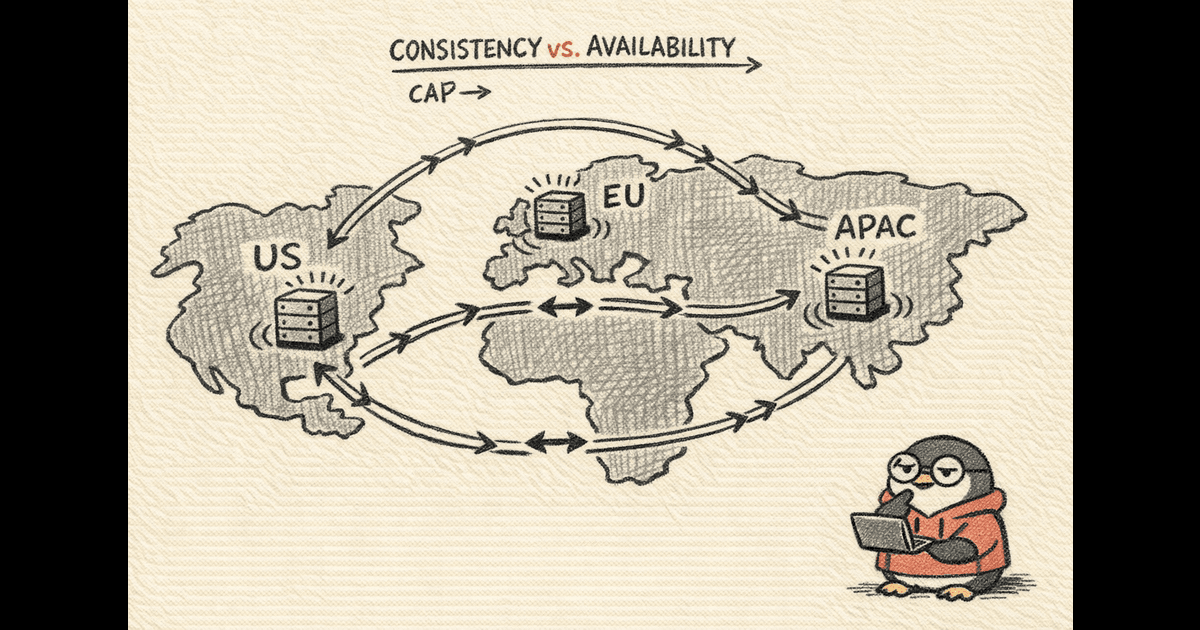
Martin Kleppmann argued directly that CAP is "too simplistic and too widely misunderstood to be of much use for characterizing systems." I agree — I have seen candidates lose five minutes explaining CAP theorem when the interviewer just wanted to know which path gets strong consistency and which one does not. CAP is a framing tool, not a complete design. If you mention it, connect it to one product behavior the user will notice.
Forgetting idempotency
Retries happen. Queues retry. Clients retry. Webhooks retry. If you skip idempotency on a write-heavy or event-driven path, the design feels toy-sized.
Saying "eventually consistent" without naming the blast radius
This is the most common mistake I see in senior system design rounds. What becomes stale? For how long? Which user action is allowed to observe it? Kleppmann's Designing Data-Intensive Applications — the book Jay Kreps called "the bridge between distributed systems theory and practical engineering" — spends entire chapters on why these questions matter more than the label.
Solving every problem with coordination
Global locks, strongly consistent cross-region writes, and perfect ordering everywhere usually hurt more than they help. Spend coordination only where the invariant actually needs it.
The answer shape that works in interviews
For most prompts, use this order:
- define the core user action
- define the hot read and write paths
- define the data model and service boundaries
- name the first failure or scale bottleneck
- choose one trade-off and defend it
- close with observability and recovery
That structure keeps you anchored when the interviewer starts pushing on scale or failure.
A fast prep plan for distributed-systems rounds
If you have one focused week, do this:
- Review one clean explanation each of replication, partitioning, caching, and message queues.
- Practice one prompt from each family: feed, chat, rate limiter, job pipeline, and reservation.
- For every answer, force yourself to name the hot path, first bottleneck, idempotency story, and replay plan.
- Pair this with Database Interview Questions so the concepts connect instead of living in separate boxes.
The short version
Distributed systems interview questions feel intimidating because the vocabulary is big and the failure modes are real.
But the recurring moves are smaller than they look: name the product contract, follow the hot path, predict the first failure, choose the cheapest coordination that preserves the invariant, make retries safe, and make recovery visible.
If you can do that calmly, you already sound more senior than the candidate who memorized ten buzzwords and never explained why the system should work.
Once the structure is stable, rehearse it under pressure with a timed mock so you can hear where your explanation still gets fuzzy.
Practice distributed-systems.
Explain your thinking like you're in the interview.
Fin and Coco are StrongYes editorial personas from the Council of Ternary Vertices — a trinary-star animal civilization that studies Earth's coding-interview process. Anecdotes map animal-universe experience to human interview mechanics; they are NEVER human-career claims. External citations link to public primary sources.
StrongYes editorial guide grounded in the April 9, 2026 content backlog, the existing StrongYes system-design/database/data-engineering guides, the StrongYes company-guide corpus across Datadog, Snowflake, HashiCorp, and Netflix, NeetCode's current Core Skills surface, Interviewing.io's public system-design prep surface, and the System Design Primer.
Last verified Apr 15, 2026.
Practice Distributed systems.
Reading builds recognition. Explaining builds recall. Run these problems with Fin or Coco.